


Parasound Halo P 6 2.1-Channel Preamplifier and DAC
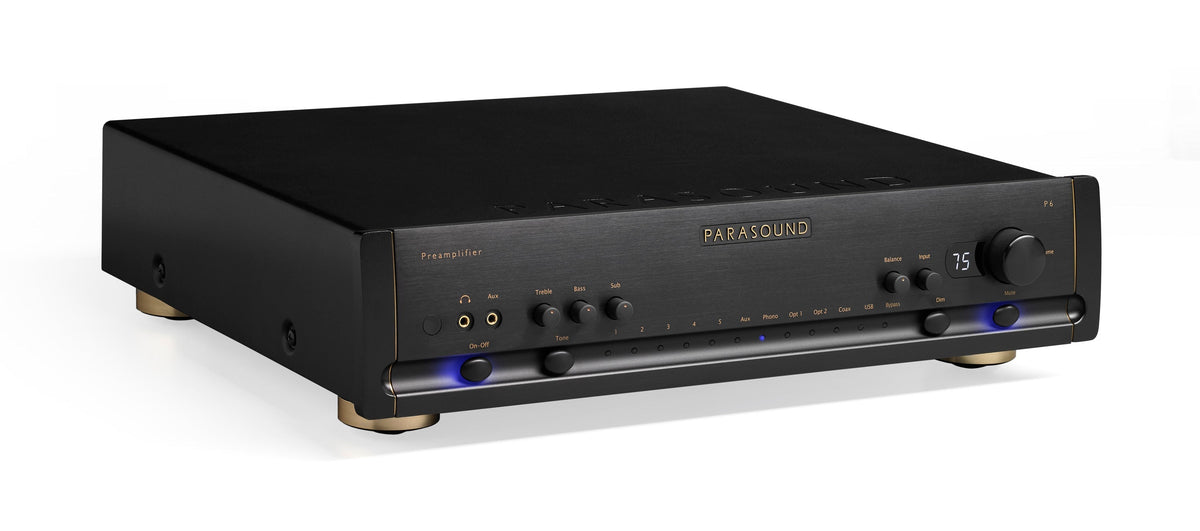
The Halo P 6 is Parasound's 2.1-channel preamplifier and DAC, designed as the control center of a two-channel system. In a 2U chassis it brings together five pairs of RCA inputs, a balanced XLR input, a phono stage, a USB DAC, a headphone amplifier and analog bass management for a subwoofer, so a turntable, a computer, a streamer and a power amplifier can all meet in one place. A back-lit remote with discrete buttons handles day-to-day control.
Type and Technology
Analog preamplifier with a built-in DAC, phono stage and headphone amplifier. Digital sources are handled by an ESS Sabre32 Reference ES9018K2M DAC behind a Savitech SA9227 USB 2.0 controller. The USB input accepts PCM up to 384 kHz/32-bit and native DSD64, DSD128 and DSD256 (with DSD over PCM at 384 kHz), and the coaxial and optical inputs accept PCM up to 192 kHz/24-bit. Volume is set by a resistor-ladder control for fine, low-noise steps, and the bass and treble controls can be bypassed by relay from the remote or the front panel.
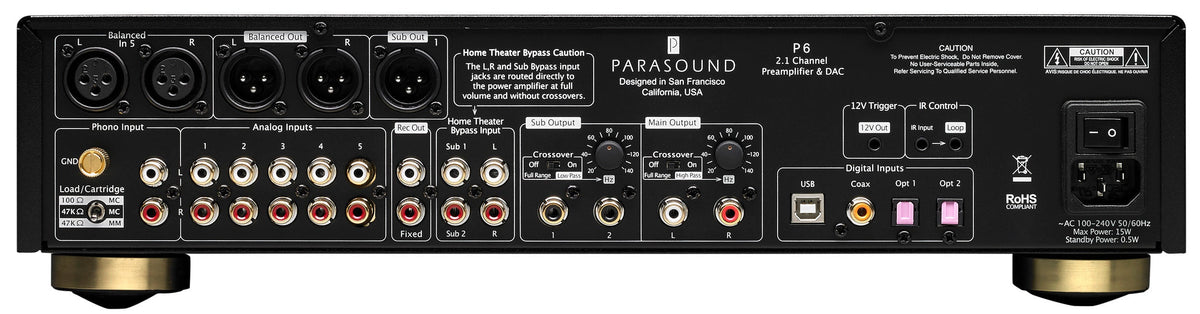
The phono input supports MM, MC and MI cartridges with 100 ohm or 47k ohm loading. A Texas Instruments TPA6120A amplifier drives the headphone output (10 ohm output impedance). Analog bass management provides independent high-pass and low-pass crossovers with 12 dB per octave slopes, one balanced XLR and two RCA subwoofer outputs, and a front-panel subwoofer level control. Analog inputs are five pairs of RCA, one balanced XLR pair and a front-panel Aux input with automatic +12 dB gain, and Parasound lists a home theater bypass for 2-channel plus surround integration. Outputs are balanced XLR and RCA preamp outputs and a 12 V trigger output, with rear-panel IR input and IR loop jacks.
Sound Character
Reviewers describe a preamplifier that adds very little of its own, though they differ a little on tonal balance. Positive Feedback heard a slight warm tilt with no damaging artifacts, strong bass control that kept synth bass separate from kick drums, air, body and resolution in accord, dynamics that were not rounded off, and a still background over USB. It placed the presentation slightly back in the soundstage but found the width gigantic, and concluded the unit imparts very little signature of its own. Part-Time Audiophile, using it with a Parasound JC 5, called it a bit on the dry and accurate side and faithful to the recording rather than colored: not the most resolving preamplifier its reviewer had heard, but equal to his reference in nearly every way. The balance control tightened a wandering center image. Both reviewers liked the phono stage, and Part-Time Audiophile judged the on-board DAC as good as or better than most dedicated DACs in the $500 to $1,500 range. Positive Feedback also found that the balanced inputs defined the sound better than the single-ended ones.
Build and Finish
A 2U chassis in black, 17-1/4 inches wide and 14 lb (6.3 kg), with a back-lit remote that reviewers found easy to use. Positive Feedback noted a thicker-than-average steel chassis and metal fittings. Parasound offers rack-mount kits separately. The log-taper volume control took one reviewer some getting used to, and another found the number of connections and controls a little overwhelming at first.
Best For
Listeners who want one capable control center ahead of a power amplifier: a turntable on the phono stage, a computer or music server on USB, a streamer, CD player or console on the other inputs, headphones on the front panel and a subwoofer managed by the analog crossovers. It pairs naturally with Parasound's Halo A 23+, JC 1+ and JC 5 power amplifiers, and reviewers used it with an A 21+ and a JC 5. Digital inputs are USB, coaxial and optical, so add a streamer for network sources. A few practical notes from reviewers: keep optical cables under six feet for hi-res files, as the manual advises; input 5 shares its RCA and XLR connectors, so only one can be used at a time; and the adjustable high-pass filter applies to the RCA main outputs, not the XLR outputs.
What's in the Box
- Parasound Halo P 6 preamplifier and DAC
- Power cord
- 3.5 mm trigger wire
- Remote control with two AA batteries
- USB cable
- Quick start card
Specifications
| Specification | Value |
|---|---|
| Type | 2.1-channel preamplifier with DAC, phono stage and headphone amplifier |
| Frequency response | 10 Hz - 100 kHz (+0/-3 dB), 20 Hz - 20 kHz (+0/-0.5 dB) |
| THD | <0.01% |
| Inter-channel crosstalk | >70 dB at 20 kHz, >78 dB at 1 kHz |
| Preamp sensitivity and gain | 300 mV in for 1 V out, 10 dB total gain |
| Maximum output | 7.5 V |
| Signal-to-noise ratio, line inputs 1 to 5 | >108 dB (IHF A-weighted, input shorted), >88 dB (unweighted) |
| Signal-to-noise ratio, DAC inputs | >108 dB (IHF A-weighted), >88 dB (unweighted) |
| Signal-to-noise ratio, phono | MM >80 dB (IHF A-weighted), >70 dB (unweighted); MC >67 dB (IHF A-weighted), >55 dB (unweighted) |
| Phono gain and input impedance | MM 38 dB / 47k ohms; MC 52 dB / 47k ohms or 100 ohms (MI supported) |
| Input impedance | Unbalanced 24k ohms, balanced 100k ohms per leg |
| Output impedance | Unbalanced 100 ohms, balanced 470 ohms per leg |
| Bass management | High-pass and low-pass crossovers, 12 dB per octave |
| DAC | ESS Sabre32 Reference ES9018K2M, 384 kHz/32-bit |
| USB input | USB 2.0 (Savitech SA9227), PCM up to 384 kHz/32-bit, native DSD64, DSD128 and DSD256, DSD over PCM at 384 kHz |
| Coaxial and optical inputs | PCM up to 192 kHz/24-bit |
| Headphone amplifier | Texas Instruments TPA6120A, 10 ohm output impedance |
| Analog inputs | 5 pairs RCA, 1 pair balanced XLR, front-panel Aux (automatic +12 dB gain), phono (MM, MC, MI) |
| Outputs | Balanced XLR and RCA preamp outputs, 1 balanced XLR and 2 RCA subwoofer outputs, 12 V trigger output |
| Other connections | Rear-panel IR input and IR loop output |
| Dimensions (W x H x D) | 17-1/4 x 4-1/8 x 15" (437 x 105 x 381 mm) with feet, 17" (432 mm) deep with cables; 3-1/2" (89 mm) tall without feet, 2U |
| Weight | 14 lb (6.3 kg) net, 21 lb (9.5 kg) shipping |
| Power consumption | Standby 0.5 W, on 15 W |
| Power requirement | 100 - 250 VAC, 50/60 Hz (automatic) |
| Finish | Black |
| Warranty | Parasound 3-year parts and labor warranty (terms effective September 1, 2026) |