


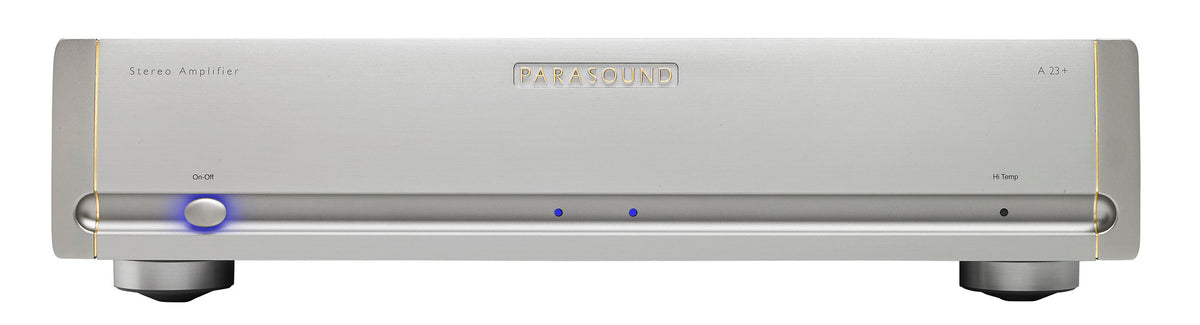
Parasound Halo A 23+ Stereo Power Amplifier
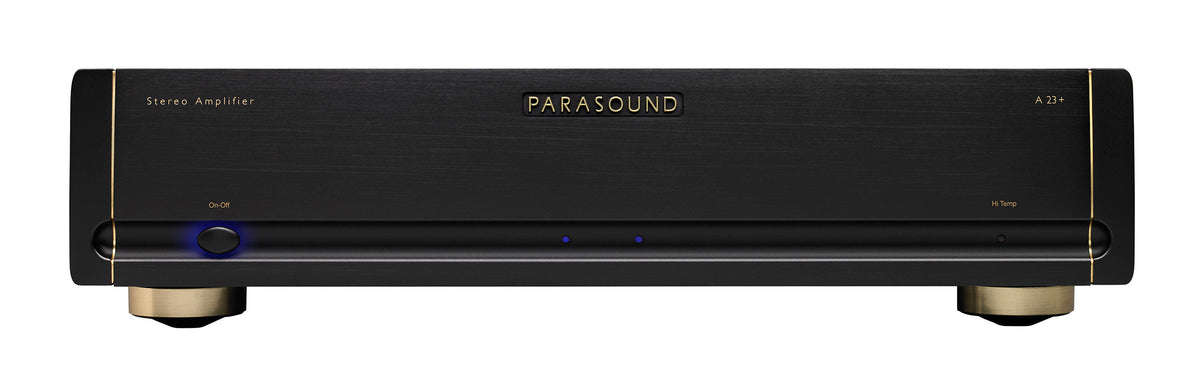
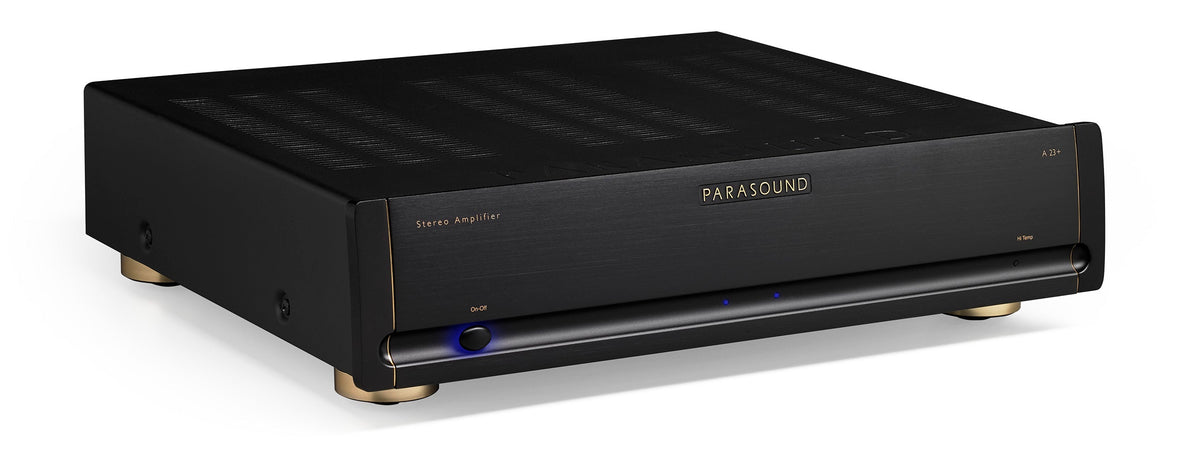
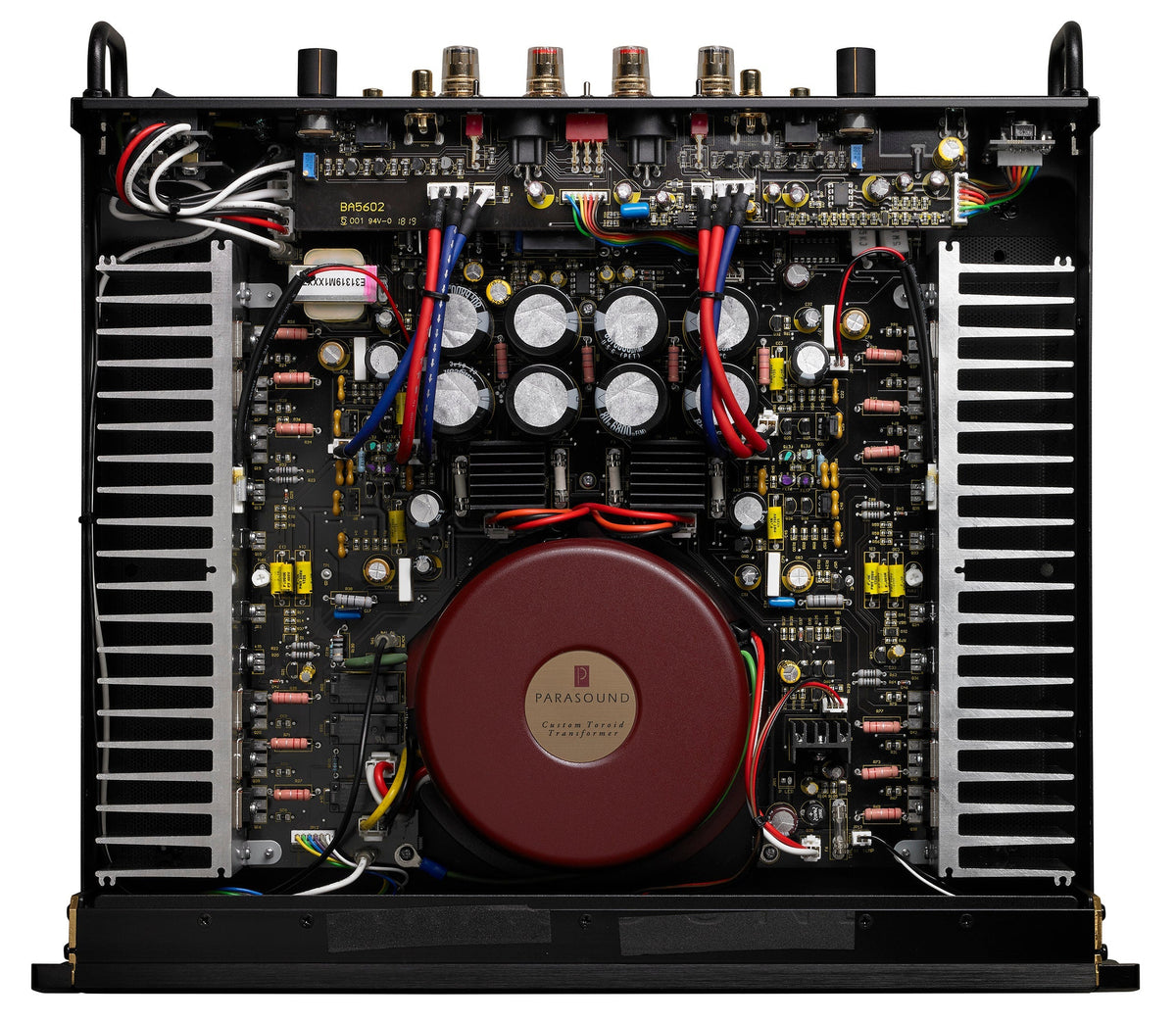
The Halo A 23+ is Parasound's compact stereo power amplifier, with circuitry designed by John Curl and built into a low 2U chassis with rear carry handles. The front panel is deliberately quiet, just a single backlit power button and a few small status lights, so nothing competes with the music. Inside, a 1.1 kVA toroidal transformer, discrete JFET and MOSFET stages and twelve matched bipolar output transistors deliver 160 watts per channel into 8 ohms and 240 watts into 4 ohms, with a bridged mono mode that reaches 500 watts for speakers that want more.
Type and Technology
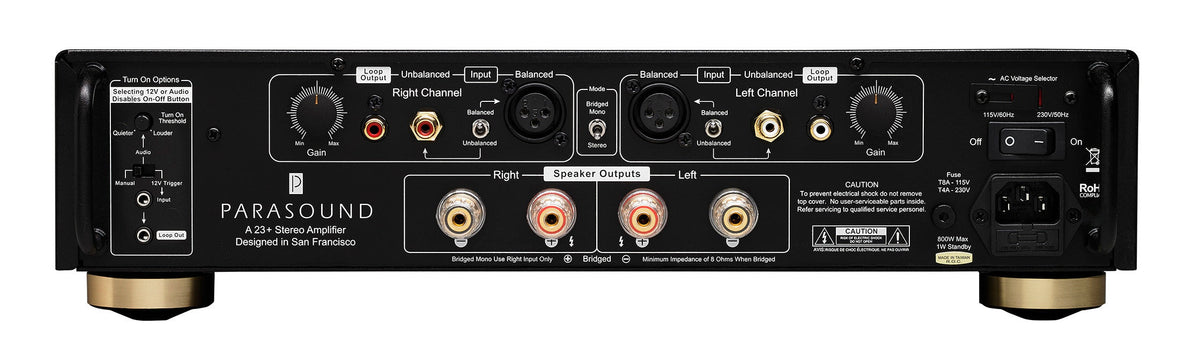
Stereo power amplifier, solid-state, high-bias Class A/AB. The signal path is direct-coupled, with no capacitors or inductors in the audio path, running from discrete balanced inputs through a JFET input stage and a MOSFET driver stage to twelve matched 15 A, 60 MHz bipolar output transistors. A 1.1 kVA shielded toroidal transformer with independent windings for each channel feeds separate power supplies for the input, driver and output stages, backed by 54,400 µF of output-stage filter capacitance and Harris soft-recovery bridge rectifiers. Parasound rates the amplifier at 45 A of peak current per channel and stable into speaker impedance dips below 2 ohms, with full power rated down to 5 Hz. A DC servo and relay protection safeguard the speakers, and AC turn-on inrush protection with a relay bypass softens power-up. Inputs are balanced XLR and gold-plated RCA, with RCA loop outputs, and a stereo/bridged-mono switch converts the amplifier to a single 500 watt channel into 8 ohms. Bridged operation into 4 ohms is not recommended.
Sound Character
Reviewers describe the A 23+ as neutral, quiet and controlled rather than warm or colored. SoundStage! Access heard a balanced presentation with detail and precision, especially on high-resolution recordings: deep, natural bass that stayed uncongested on timpani and double bass, a clear midrange that let individual instruments be placed within the stage, clean and refined treble, and well-defined images across the soundstage. Dynamics were a strong point, with punch at higher volumes and fine microdynamic contrast at low level, and the amplifier stayed quiet throughout. In that review, driving a pair of compact Sonus Faber monitors, it sounded cleaner, more refined and more controlled than a $900 integrated amplifier it was compared against.
Build and Finish
A 2U chassis with rear carry handles, finished in black or silver. Speaker connections are heavy-duty 24k gold-plated 5-way binding posts, and rack-mount hardware is available separately from Parasound. At 27 lb it is easy to place, and in SoundStage! Access's review it ran cooler than the integrated amplifier it was compared against, provided it had room to breathe above it. The amplifier can be switched on by a 12 V trigger or by audio sensing, so it can power up and down with the rest of the system, and a rear-panel selector covers 110 to 125 VAC or 220 to 250 VAC mains.
Best For
Listeners who want a clean, powerful stereo amplifier for a two-channel system without paying for features they will not use. Its current capacity and stability into low impedances suit a wide range of speakers, from compact monitors to demanding floorstanders, and the bridged mono mode lets a pair of A 23+ amplifiers serve as 500 watt monoblocks for 8 ohm speakers that want more power. It pairs naturally with Parasound's Halo P 6 or any preamplifier with balanced or RCA outputs, and the 2U chassis sits as comfortably in a rack as on a shelf.
What's in the Box
- Parasound Halo A 23+ stereo power amplifier
- Power cord
- 3.5 mm trigger wire
- Quick start card
Specifications
| Specification | Value |
|---|---|
| Type | Stereo power amplifier, solid-state, high-bias Class A/AB |
| Circuit design | John Curl |
| Power output, stereo (0.06% THD, both channels driven) | 160 W x 2 into 8 Ω; 240 W x 2 into 4 Ω |
| Power output, stereo (0.9% THD, both channels driven) | 210 W x 2 into 8 Ω; 300 W x 2 into 4 Ω |
| Power output, bridged mono | 500 W into 8 Ω at 0.06% THD (600 W at 0.9% THD); bridged 4 Ω operation not recommended |
| Power measurement conditions | 120 VAC, RMS continuous, full audio band (20 Hz - 20 kHz) |
| Current capacity | 45 A peak per channel |
| Slew rate | Greater than 130 V/µs |
| Frequency response | 5 Hz - 100 kHz, +0/-3 dB; 20 Hz - 20 kHz, +0/-0.25 dB |
| Total harmonic distortion | Less than 0.06% at full power; less than 0.03% at typical listening levels |
| IM distortion | Less than 0.04% |
| Inter-channel crosstalk | Greater than 85 dB at 1 kHz; greater than 70 dB at 20 kHz |
| Input impedance | Unbalanced 33 kΩ; balanced 66 kΩ (33 kΩ per leg) |
| Total gain | 29 dB |
| Input sensitivity (28.28 V out, 8 Ω) | Unbalanced 1 V; balanced 1 V per leg |
| Signal-to-noise ratio | Greater than 112 dB (input shorted, IHF A-weighted); greater than 107 dB (unweighted) |
| Damping factor | Greater than 800 at 20 Hz |
| Inputs | Balanced XLR and gold-plated RCA, with RCA loop outputs |
| Speaker outputs | 24k gold-plated 5-way binding posts |
| Turn-on | 12 V trigger (+9 to +12 Vdc, 5 mA) or audio sensing (2 to 10 mV) |
| Dimensions (W x D x H) | 17-1/4" x 15-1/4" x 4-1/8" (437 x 388 x 105 mm), 2U; height without feet 3-1/2" (89 mm) |
| Weight | 27 lb (12.2 kg) net; 34 lb (14.4 kg) shipping |
| Power consumption | Under 1 W standby; 75 W idle; 125 W typical listening; 800 W maximum |
| AC mains | 110 - 125 VAC 60 Hz or 220 - 250 VAC 50 Hz (rear-panel selector) |
| Finishes | Black, Silver |
| Warranty | 3 years parts and labor |